

Recently, I gently pointed out to a friend that she seemed to be viewing everything through a negative lens. She didn’t become defensive. Instead, she thanked me.
The very next day, something wonderful she had been waiting for finally happened.
Did changing her attitude cause the event? I can’t say that. But I do know that when we loosen negativity’s grip, we become more able to recognize possibility, receive good news, and participate in life with an open heart.
Her response also caused me to look honestly at myself:
I’ve been complaining too.
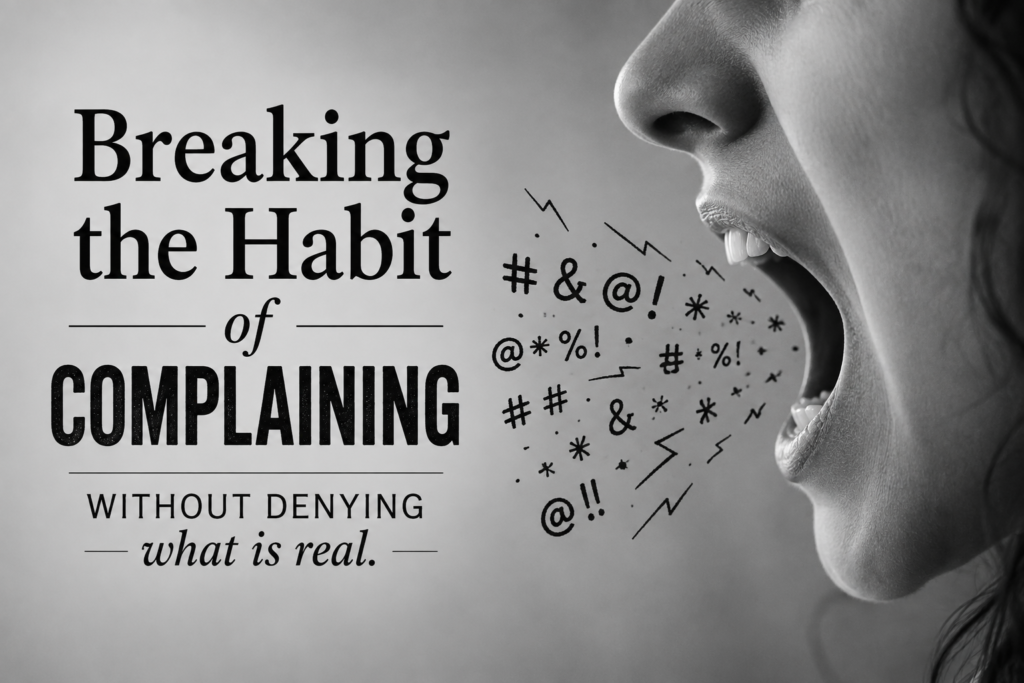
When we are sick, in pain, financially strained, or surrounded by uncertainty, complaining is an easy trap to fall into. We may have legitimate reasons to feel frustrated. Sometimes we need to tell the truth about how difficult life has become.
But there is a difference between expressing pain and building a home inside it.
How the Habit Takes Root
The brain naturally looks for danger. This “negativity bias” once helped human beings survive, but today it can keep us continually scanning for what is wrong.
One complaint leads to another:
The weather is unbearable.
My body isn’t cooperating.
Nothing is going according to plan.
People don’t understand.
The world feels frightening.
Eventually, we stop noticing that we are doing it. Complaining becomes the background music of our lives.
This doesn’t mean our problems aren’t real. It means that repeatedly focusing on them may leave us feeling even more helpless, exhausted, and disconnected from the good that still exists.
Venting or Complaining?
Healthy venting usually has a purpose. We express what hurts, feel heard, and then move toward comfort, acceptance, a boundary, or a solution.
Habitual complaining circles the same problem without creating movement.
Before speaking, we might ask:
“Am I sharing this because I need support, or am I repeating a familiar pattern?”
Both answers deserve compassion. Awareness is not self-criticism—it is the beginning of choice.
How to Nip Negativity in the Bud
1. Catch It Without Shaming Yourself
Simply notice:
“I’m caught in a complaint loop.”
Don’t add another layer by criticizing yourself for being negative. A habit changes more easily through awareness and kindness than through shame.
2. Honor What Is True
Positive thinking should never require us to pretend.
Try saying:
“This is genuinely difficult, and it is not the whole story.”
The word and allows pain and possibility to exist together.
3. Move From Complaint to Request
Ask yourself:
- What do I need?
- Is there one action I can take?
- Do I need help, rest, information, reassurance, or simply someone to listen?
Instead of saying, “No one ever helps me,” try:
“I’m overwhelmed. Would you be willing to help me with this?”
A clear request creates movement.
4. Ask Permission Before Venting
We can say:
“I’m having a hard moment. Do you have five minutes to listen?”
This respects the other person’s emotional capacity and gives our sharing a beginning and an ending.
5. Use the Three-to-One Reset
After naming one difficulty, identify three things that are supportive, improving, or still working.
They don’t have to be dramatic:
- I have clean water.
- Someone checked on me.
- My body carried me through today.
- I saw something beautiful.
- I made one good decision.
- Tomorrow offers another beginning.
Gratitude doesn’t erase hardship. It widens the frame around it.
6. Take a Complaint and Add a Possibility
Try completing this sentence:
“This is hard, but one thing I can do is…”
Perhaps you can make a phone call, rest for twenty minutes, ask a question, change your environment, pray, breathe, or decide that today’s answer is simply not yet.
7. Choose Your Inputs Carefully
Uncertainty in the world can keep the nervous system on constant alert. Consider limiting repetitive news, frightening social media, and conversations that leave you feeling powerless.
Being informed is useful. Being continuously flooded is not.
8. Invite Loving Accountability
My friend welcomed my observation because it was offered with care. We can ask someone we trust:
“If you hear me getting stuck in negativity, please gently help me notice.”
Sometimes we need another person to hold up the mirror—but the mirror should be held with love.
A Gentle Daily Practice
At the end of each day, write down:
- Something difficult I experienced
- Something I did well
- Something that supported me
- Something I am looking forward to
This practice gives hardship its rightful place without allowing it to occupy the entire page.
We Are Not Denying the Darkness
Nipping negativity in the bud does not mean silencing grief, tolerating mistreatment, or pretending illness is easy. It means refusing to let suffering become the only voice in the room.
We can acknowledge what hurts while remaining available to what heals.
We can say:
“Yes, this is difficult. Yes, I am tired. And something good may still be making its way toward me.”
We all fall into the trap of complaining—especially when life and the world feel uncertain. The goal isn’t perfection. The goal is to notice sooner, soften the pattern, and gently turn ourselves back toward possibility.
Sometimes the first sign of change is simply catching the complaint before it takes root.
And sometimes, just beyond our current view, something wonderful is already unfolding.
Wheel of Wellness Coaching Restoring Body, Mind, and Spirit