
When One Feeling Is Really Many
Living with illness doesn’t affect only the body.
It changes plans. Relationships. Identity. Independence. Finances. Confidence. Our relationship with the future and sometimes even our sense of safety in our own bodies.
And yet when someone asks, “How are you feeling?” we may have no idea how to answer.
“Sad.”
“Scared.”
“Frustrated.”
“Overwhelmed.”
But those words may barely scratch the surface.
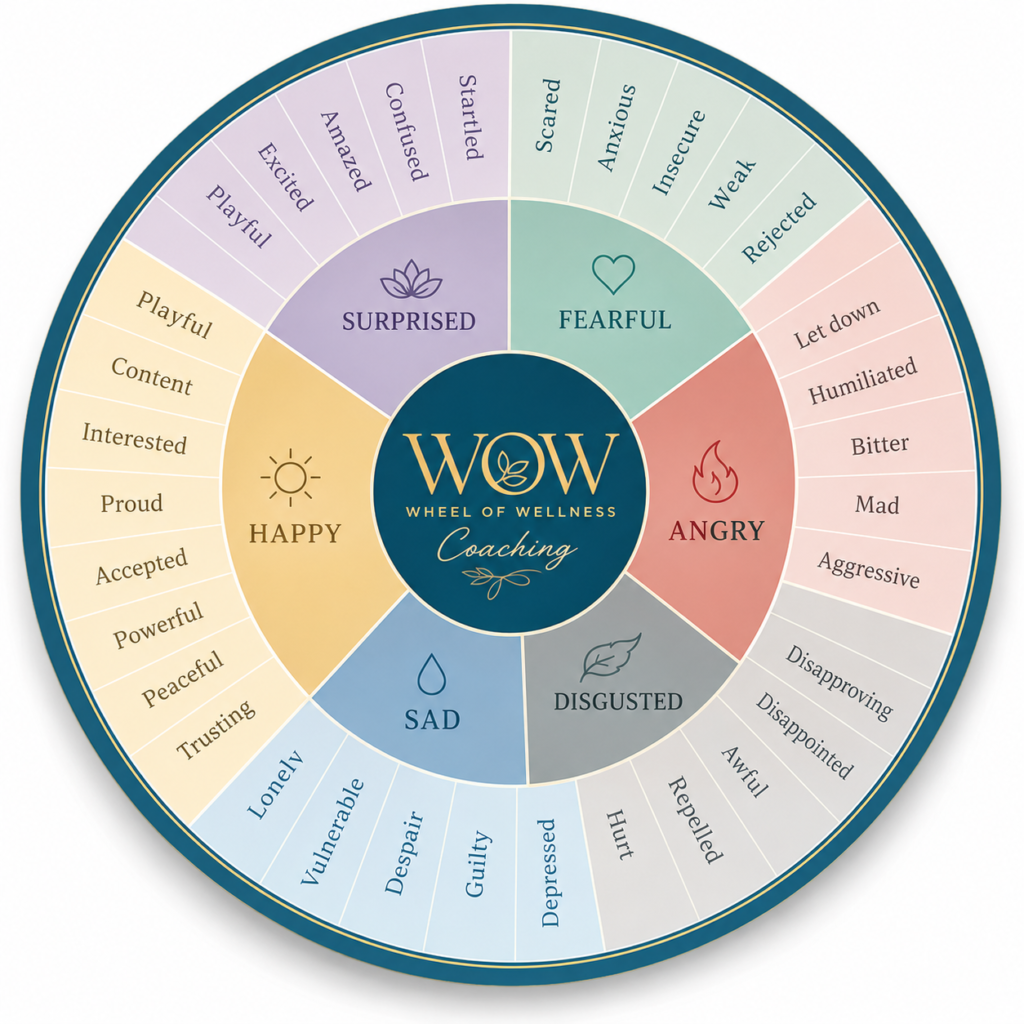
One of the most helpful things I’ve learned is that what feels like one enormous emotion may actually be many smaller emotions happening simultaneously.
The work isn’t necessarily to make them disappear.
It is to untangle them.
When Every Emotion Gets Pulled Into the Room
Imagine that something happens related to your illness.
A symptom returns.
A test result is abnormal.
A treatment doesn’t work.
You have to cancel plans.
Someone questions what you’re experiencing.
You see other people effortlessly doing something your body currently won’t allow.
Suddenly, you’re overwhelmed.
It may seem as though the situation itself caused this enormous reaction. But if we slow it down, we might discover:
I am afraid.
But that’s not all.
I’m grieving.
And I’m angry.
And disappointed.
And lonely.
And somewhere underneath those feelings might be shame:
Why can’t I handle this better?
And underneath the shame might be doubt:
What if I’m doing something wrong?
And underneath the doubt might be fear again:
What if this never gets better?
These emotions have become tangled together.
When they arrive as one mass, our nervous system can interpret them as:
DANGER.
But when we separate them, something changes.
Instead of experiencing one enormous unnamed storm, we begin recognizing individual clouds.
The Emotion Is Not the Enemy
We often try to talk ourselves out of difficult emotions.
Don’t be afraid.
Stay positive.
You should be grateful.
Other people have it worse.
But emotions aren’t necessarily problems requiring correction.
They are information.
Fear may be asking for safety.
Grief may be asking us to acknowledge what we’ve lost.
Anger may be telling us that something feels unfair or that a boundary has been crossed.
Loneliness may be telling us we need witness and connection.
Shame may be revealing an impossible expectation we’ve placed upon ourselves.
Jealousy may simply be grief wearing different clothing.
When I think, Why can everyone else do that?, perhaps what I’m really saying is:
I miss my freedom.
That is very different from judging myself for feeling jealous.
Separate Before You Soothe
The next time illness triggers a large emotional response, rather than immediately trying to calm yourself, try asking:
What exactly am I feeling?
Take the emotions one at a time.
Fear
I’m afraid my symptoms will become worse.
Don’t argue with fear.
Answer it:
“I don’t have to know how my entire future unfolds. I only need to meet this moment.”
Grief
I’m grieving the life I thought I would be living.
Let grief tell the truth.
Then answer:
“I am allowed to mourn what has changed while remaining open to what can still become.”
Anger
I’m angry that I’ve had to deal with this for so long.
Anger doesn’t make us negative or ungrateful.
Answer:
“My anger acknowledges what this has cost me. I can listen to it without allowing it to control me.”
Shame
I should be stronger. I should be accomplishing more.
Ask whose standard you’re measuring yourself against.
Then answer:
“My worth is not measured by my productivity or by what my body can accomplish today.”
Doubt
What if I’m making the wrong decisions? What if I can’t trust myself?
Answer:
“I don’t need perfect certainty to trust myself. I can gather information, listen carefully and make the best decision available to me today.”
Helplessness
Nothing I do matters.
Instead of demanding that you feel powerful, find one place where choice remains.
Then answer:
“There are things I cannot control. There are also things I can influence. Today I will place my energy there.”
Loneliness
Nobody understands what this is like.
Sometimes this one is particularly painful because illness can create experiences that are difficult to explain to someone who hasn’t lived them.
Answer:
“Being misunderstood does not make my experience less meaningful. I am worthy of companionship, understanding and witness.”
Notice. Name. Separate. Listen. Replant.
This can become a simple practice.
NOTICE
Something has activated me.
Instead of immediately reacting, I notice what is happening inside.
NAME
What am I actually feeling?
Fear?
Shame?
Anger?
Grief?
Doubt?
Helplessness?
Loneliness?
Resentment?
Disappointment?
SEPARATE
Instead of saying:
“I’m completely overwhelmed.”
I might say:
“Part of me is frightened. Part of me is grieving. Part of me is angry. And another part of me feels alone.”
Already, the experience has changed.
There isn’t one enormous monster anymore.
There are four emotions.
And each can be approached individually.
LISTEN
Ask each emotion:
What are you trying to tell me?
Fear might say:
I need reassurance.
Grief:
I need permission to mourn.
Anger:
I need a boundary.
Loneliness:
I need connection.
Shame:
I need compassion.
Doubt:
I need to remember what I already know.
REPLANT
Now choose a thought that is both compassionate and believable.
Not:
Everything is wonderful.
But:
“This is difficult, and I can meet this moment.”
Not:
I’m completely healed.
But:
“My body deserves patience, care and partnership.”
Not:
I’m not afraid.
But:
“Fear is present, and I am still here.”
That distinction matters.
An affirmation shouldn’t silence an emotion.
It should give the emotion somewhere safer to land.
Illness Is Something We Experience, Not All That We Are
Perhaps one of the deepest emotions underneath chronic illness is the fear that illness has swallowed our identity.
Our conversations become about symptoms.
Our calendars become appointments.
Our money goes toward treatments.
Our decisions revolve around what our bodies can tolerate.
And eventually we may wonder:
Where did I go?
But there is a person underneath all of this.
A person who still loves.
Creates.
Laughs.
Imagines.
Learns.
Contributes.
Prays.
Dreams.
Not every part of life has to wait until the body is perfectly well.
Sometimes healing also means reclaiming pieces of ourselves while uncertainty remains.
When the Storm Comes
The next time everything rises at once, I want to remember:
This is not one giant feeling.
Let me untangle it.
What is fear?
What is grief?
What is anger?
What is shame?
What is doubt?
What is loneliness?
What actually belongs to this moment—and what has been pulled into it from yesterday?
Then I can sit with each feeling separately and say:
I see you.
I understand why you’re here.
You don’t have to disappear for me to be okay.
But you don’t have to run the whole house either.
I can be frightened and courageous.
Grieving and grateful.
Uncertain and hopeful.
Tired and still moving forward.
Angry and loving.
Ill and still deeply alive.
Healing may not always mean eliminating what we feel.
Sometimes healing begins when we can finally distinguish one feeling from another, listen to what each is asking for, and gently choose what we want to plant in its place.
I am more than what I am feeling in this moment.
I am more than what my body is experiencing today.
I can hold difficult emotions without becoming them.
One feeling at a time.
One breath at a time.
One moment at a time.
Karen
A lot to digest, Ronda. I love that emotions don’t define the whole of who we are.
178004305
And I love that it is within our power to dismantle them.