

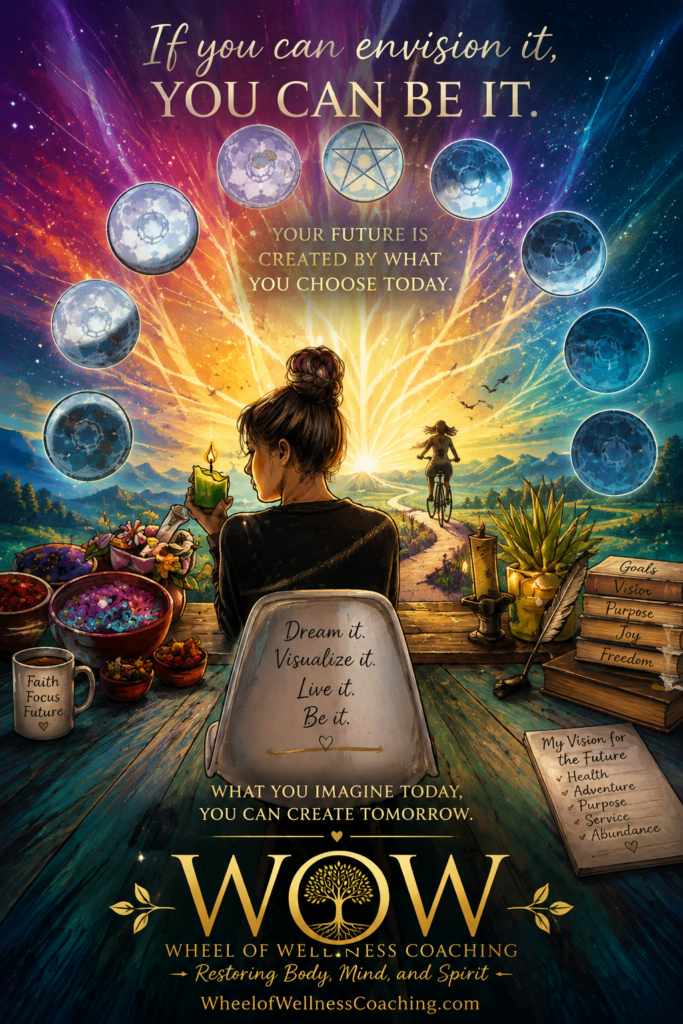
What if your brain couldn’t tell the difference between an experience you vividly imagined and one you actually lived?
While that may sound extraordinary, neuroscience has shown that mentally rehearsing experiences can activate many of the same neural pathways involved in physically performing them. This is why elite athletes, musicians, astronauts, and surgeons have used visualization for decades—not as wishful thinking, but as a way to prepare the mind and body for success.
This concept has also inspired fascinating work by researchers such as Dr. William Bengston, whose Image Cycling technique encourages people to rapidly move through emotionally meaningful images of a life they desire.
Why It Matters
Most of us don’t realize that our minds rehearse all day long.
Unfortunately, many of those rehearsals are fear-based.
“What if I get sick?”
“What if I fail?”
“What if nothing changes?”
Our brains become incredibly efficient at practicing the future we don’t want.
Future Image Cycling invites us to practice something different.
Instead of replaying fear, we intentionally rehearse wellness, joy, purpose, connection, peace, and possibility.
The Brain Learns Through Repetition
Every repeated thought strengthens a neural pathway.
The more often we imagine ourselves healthy, engaged, laughing with friends, traveling, creating, serving others, or waking up full of energy, the more familiar those experiences become to our nervous system.
This isn’t pretending our challenges don’t exist.
It’s giving our brains another destination to navigate toward.
My Personal Image Cycle
Every morning and evening, I spend a few minutes cycling through images that represent the life I’m creating.
I see myself…
🌅 Watching the sunrise with a cup of tea.
💙 Coaching clients who regain hope after years of complex illness.
📚 Writing books and articles that inspire healing.
🎤 Speaking to audiences about restoring body, mind, and spirit.
🎶 Dancing, laughing, listening to music, and celebrating life.
👭 Sharing meaningful conversations with friends and community.
🌿 Walking confidently, feeling strong and vibrant.
✈️ Traveling to beautiful places filled with peace and wonder.
🙏 Living each day with gratitude and purpose.
These aren’t just dreams.
They’re reminders of who I’m becoming.
A Different Kind of Healing
Healing is more than reducing symptoms.
It’s expanding our capacity for joy.
It’s teaching the nervous system that life contains safety, beauty, connection, and hope—not just appointments, lab work, and recovery.
The future we repeatedly imagine influences the future we’re preparing ourselves to recognize.
Try It Yourself
Create 15–20 images that represent your happiest, healthiest, most meaningful life.
Choose images that make you smile immediately.
Cycle through them fairly quickly, spending just a few seconds on each.
Repeat the cycle morning and evening.
Don’t analyze.
Don’t force.
Simply allow your mind and body to become familiar with possibility.
Remember…
Your brain is always rehearsing something.
Choose to rehearse a future filled with health, purpose, love, laughter, and peace.
The seeds you water today may become the life you live tomorrow.
Reflection
“Where attention goes, energy flows. Where imagination goes, possibility grows.”
Learn More About the Origins of Image Cycling
The Image Cycling technique was developed by Dr. William Bengston, a sociologist and researcher best known for studying the relationship between consciousness, intention, and healing. For decades, he has explored how focused mental imagery may influence biological processes, particularly through laboratory research involving animals and cancer models.
While the exact mechanisms remain an area of ongoing scientific investigation, Dr. Bengston’s work has inspired many people to explore the potential of intentional visualization as a complementary practice alongside conventional medical care.
His approach to Image Cycling encourages people to rapidly move through a series of vivid, emotionally meaningful images that represent the life they wish to create. Rather than focusing on illness or limitations, the practice shifts attention toward health, joy, purpose, connection, and possibility.
If you’d like to learn more about his research and teachings, I encourage you to explore Dr. Bengston’s books, lectures, interviews, and published scientific papers. Whether you’re simply curious or looking to expand your understanding of the mind-body connection, his work offers a fascinating perspective on the power of imagination and intention.
As always, practices like Image Cycling are best viewed as complementary tools that can support overall well-being while working in partnership with your healthcare team.
🌿 Wheel of Wellness Coaching (WOW)
Restoring Body, Mind, and Spirit