
When I began losing my hair from chemotherapy, it was difficult to wake each morning and see more of it scattered across my pillow.
Hair loss had been one of the many “what ifs” that frightened me when I was first diagnosed with breast cancer. But once it began happening, I realized I did not want to lose my hair slowly, strand by strand, watching it disappear a little more every day.
I wanted to make a choice.
My eldest daughter, Jennifer, was sixteen at the time. Together, we went to Great Clips, where our family usually had our hair cut, and I asked them to shave my head.
It was an emotional moment. There is no way to pretend otherwise. Cancer treatment asks us to surrender so many things—our routines, our privacy, our sense of control and, sometimes, parts of our familiar appearance.
But next door to Great Clips was a Sally Beauty Supply store.
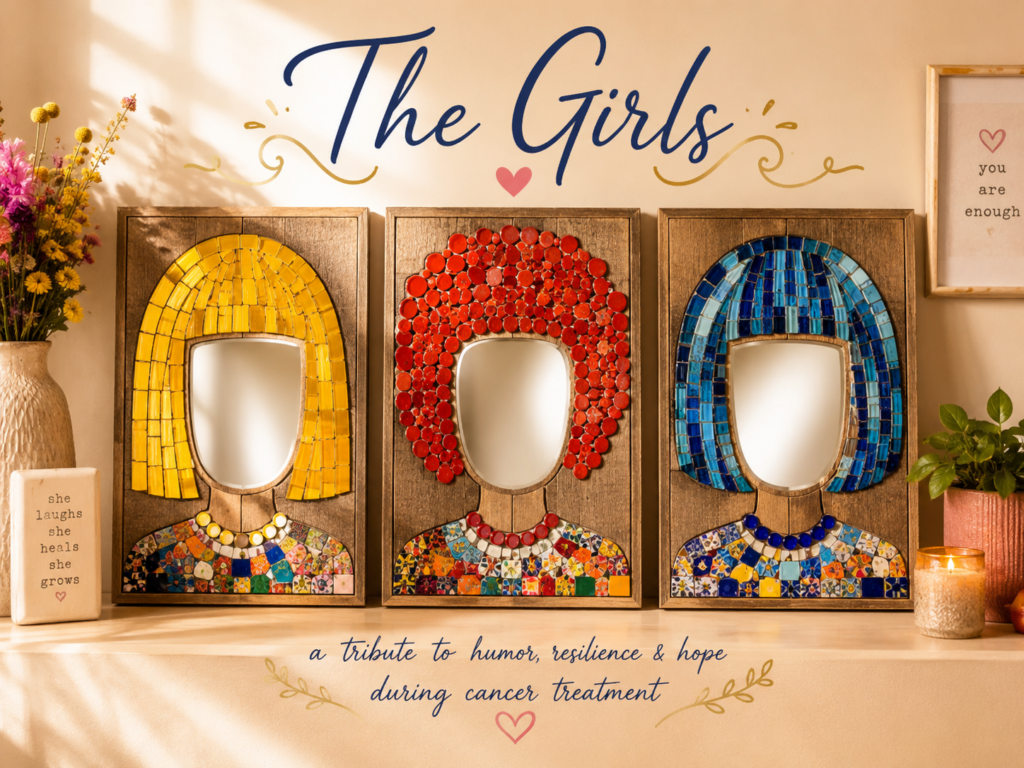
In the window hung three outrageous wigs: a straight yellow wig, a curly red wig and a blue pageboy-style wig.
I looked at Jennifer and said, “Let’s have some fun.”
I tried on all three.
The harsh, artificial colors looked absolutely horrible on me.
And they made me laugh.
Jennifer and I laughed together, right there in the middle of one of the most difficult days of my life.
Not just then, but whenever I thought about that day afterward, I remembered the wigs. I remembered the absurd colors, my newly shaved head and the laughter I shared with my daughter.
Cancer was serious, but for that moment, it did not own the entire room.
Creating “The Girls”
I laughed about those wigs so often that I eventually decided to immortalize the occasion.
I found three wide wooden frames at IKEA, each with a small mirror in the center. Then I stocked up on colorful mosaic tiles, adhesive and grout.
After my first three chemotherapy treatments, I would sit at my dining room table and work on the frames. Slowly, I recreated each of the wigs in mosaic: one yellow, one red and one blue.
I called them The Girls.
When the project was finished, anyone who looked into one of the mirrors could see their own face surrounded by a whimsical head of bright yellow, curly red or pageboy-blue hair.
The person in the mirror became part of the artwork.
The project gave me something creative to focus on during treatment. It offered distraction, expression and purpose. It gave form to a memory that contained both grief and joy.
Most importantly, it reminded me that I was still me.
I was still a mother.
I was still an artist.
I was still capable of laughing.
I was still able to create beauty from something painful.
Finding Your Own Version of “The Girls”
Not everyone will create mosaics or try on brightly colored wigs. Your way of coping may look completely different.
Perhaps you write.
Perhaps you listen to music.
Perhaps you spend time in nature, pray, paint, garden, watch comedies or sit quietly with someone you trust.
You Can Still Be You
I eventually bought a couple of very fine, real-hair wigs. In many ways, they looked even better than my natural hair had looked before cancer.
But they were never comfortable for me personally. Everyone’s different.
And that’s perfectly all right.
Instead, I wore scarves—bright, colorful scarves tied in knots at the top of my head or flowing freely down my back. They felt lighter, more comfortable and more expressive of who I was.
Every person responds to hair loss differently. Some people feel most confident in a beautiful wig. Others prefer hats, turbans or scarves. Some choose to wear their bald heads proudly. There is no right or wrong way to move through this part of treatment.
The goal is not to look the way anyone else thinks you should look. It is to find what helps you feel most comfortable, most authentic and most like yourself.
Cancer may change the reflection you see in the mirror, but it does not take away your beauty.
Beauty is not found only in hair, breasts or an unchanged body. It lives in courage, humor, creativity, tenderness and the willingness to keep showing up as yourself—even when life has changed you.
Everyone is different.
Everyone deserves to make their own choices.
Cancer Can Affect the Body Without Owning the Spirit
Cancer is serious.
It asks a great deal from our bodies. Surgery, chemotherapy, radiation, medications, appointments and side effects can consume our time and energy.
A diagnosis can also affect the way we see ourselves. We may look in the mirror and struggle to recognize the person looking back. We may feel that our lives have suddenly been divided into “before cancer” and “after cancer.”
But illness does not have to take ownership of every part of us.
Cancer may change the body.
It may interrupt our plans.
It may temporarily take over the calendar.
But it cannot automatically steal our creativity, humor, love, identity or spirit.
Sometimes those parts of us become even more important during treatment.
They remind us that we are more than patients.
The Harder Parts Are Not Always Medical
When someone is diagnosed with cancer, the professional medical team focuses on the disease. The surgeon plans the operation. The oncologist recommends treatment. The radiation team manages radiation therapy. The nurses monitor symptoms, medications and side effects.
That medical care is essential.
But many of the hardest parts of cancer happen outside the examination room.
How do I tell my children?
What will happen to my work?
How do I ask for help?
What do I do with all this fear?
How do I prepare for losing my hair or changes to my body?
How do I keep track of appointments, questions and medical information?
How do I make decisions when my mind feels overwhelmed?
How do I respond when people tell me to “stay positive” when I am frightened, angry or exhausted?
Who will listen when I need to say the things I am afraid to say to my family?
This is where coaching can help.
How Wheel of Wellness Coaching Supports You
At Wheel of Wellness Coaching, I work with clients who are navigating a cancer diagnosis, chronic illness or another major health transition.
Your professional medical team manages your diagnosis and medical treatment.
My role is different.
I help you untangle the emotional, practical and everyday challenges surrounding the diagnosis.
Together, we can slow down the thoughts that feel as though they are arriving all at once. We can separate what needs attention today from what can wait. We can turn an overwhelming collection of fears into smaller, more manageable questions.
Coaching may help you:
- Organize questions before medical appointments
- Prepare for conversations with children and family members
- Identify the practical support you need
- Make plans for meals, transportation, work and household responsibilities
- Recognize catastrophizing and other fear-driven thinking patterns
- Find ways to calm an overwhelmed nervous system
- Stay connected to your creativity, spirituality and sense of identity
- Discover moments of meaning, humor and joy during treatment
- Reconnect with the parts of life that exist beyond the diagnosis
You do not have to arrive at a coaching session feeling strong or positive.
You are allowed to be frightened.
You are allowed to be angry.
You are allowed to grieve.
You are also allowed to laugh.
All of it belongs.
And everyone can still be beautiful—even with cancer.